
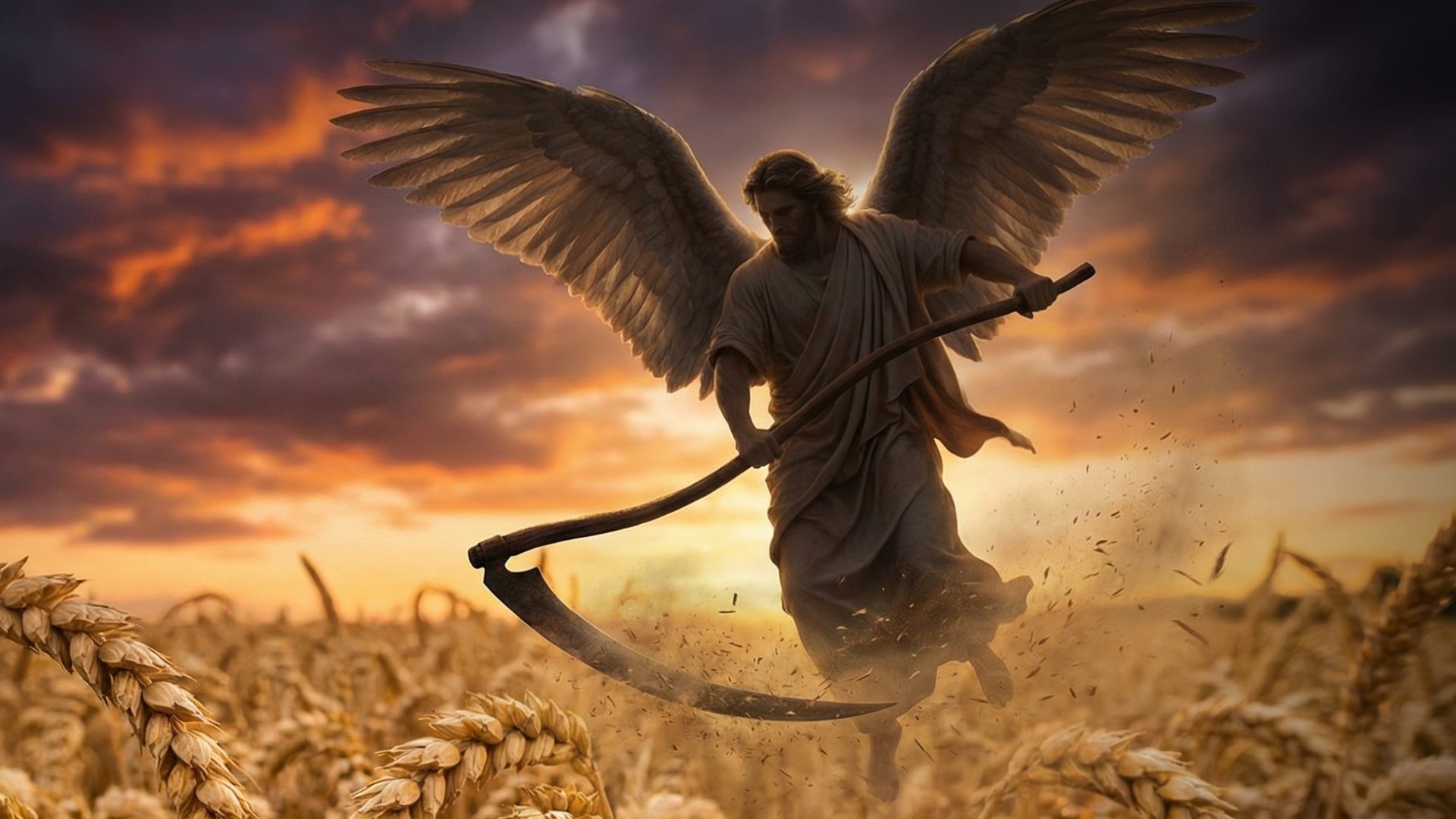
The harvest is a conclusion of a system of things, and the reapers are angels.”
– Jesus Christ –
Click image to enlarge
CHAPTER MENU
Related videos, articles
Are the angels killing off your Bible students?

When is the Kingdom harvest?
One Will Be Taken, the Other Abandoned
The Harvest is a conclusion of a system
SIDE NOTES
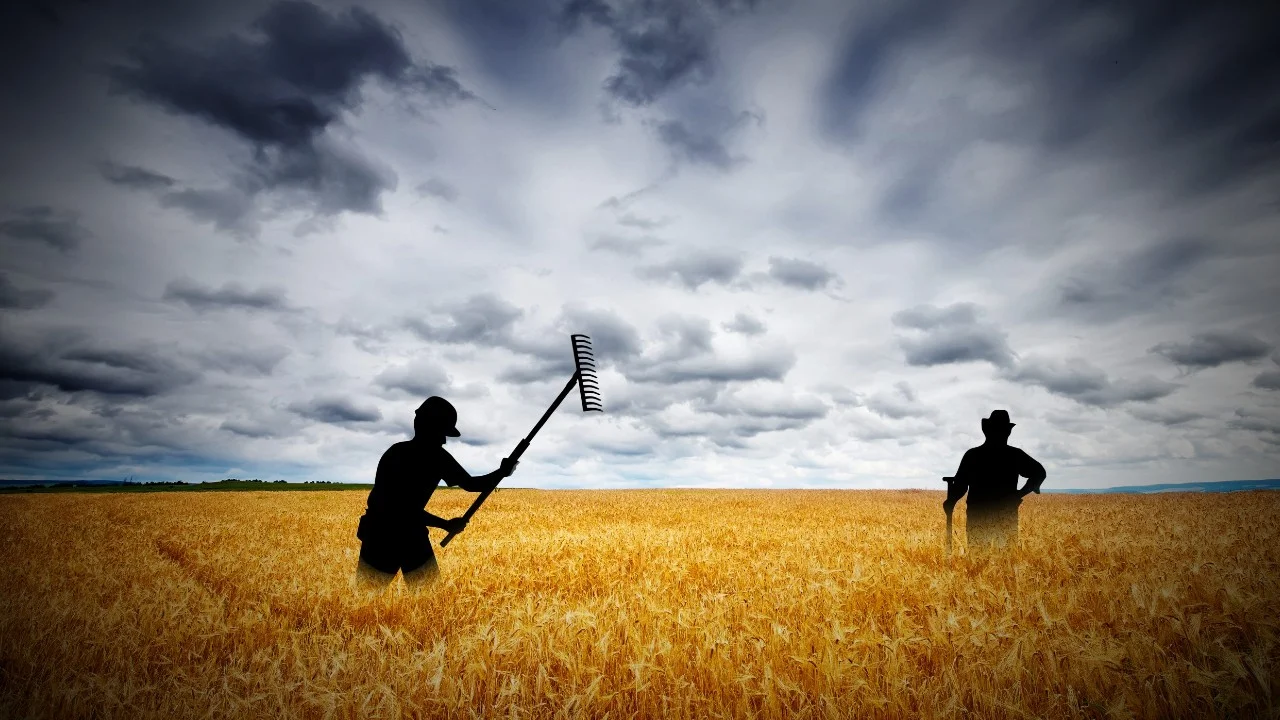
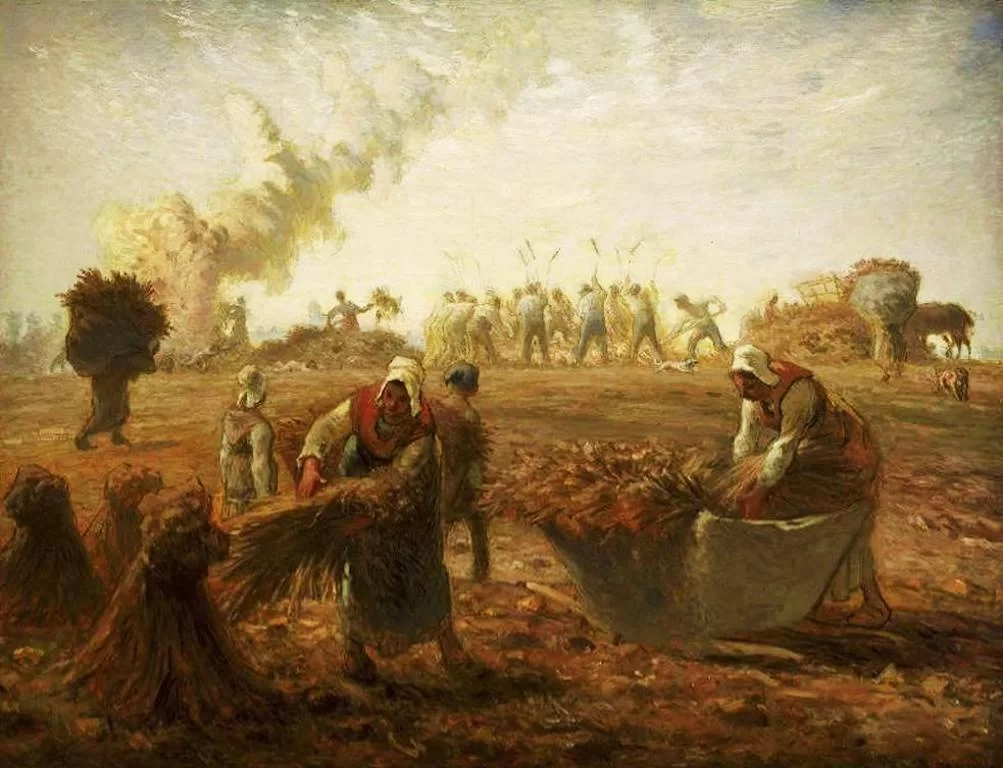
Jesus taught through illustrations, and his word pictures were always drawn from common, everyday things. He related the story of the sower who planted good wheat in a field, but an enemy oversowed it with weeds. The master allowed the wheat and weeds to grow together over an extended time. In the natural world, the growing season is always the longest period of the agricultural cycle. The harvest is typically the shortest. Before mechanized farming, when the field was ripe, everyone joined in the harvest to get the crop in before winter weather made it difficult or even ruined it. The harvest took place over a relatively short period of time compared to the growing season.
Because the Watchtower is wedded to 1914 as the beginning of the conclusion, they are compelled to concoct the absurd scenario that the harvest began in 1914 and has presumably been ongoing through successive generations of wheat and weeds. That means that the sower goes out again and again, and the enemy oversows the field with weeds over and over, all the while the angels are uprooting the weeds and reaping the wheat. It is nonsensical to be sure, but when the “faithful slave” declares something to be true, it must be accepted by Jehovah’s Witnesses or else face punishment
With or without the seven-times chronology, Jehovah’s Witnesses are absolutely convinced that the time of the end and the foretold concluding harvest commenced in 1914. However, this chapter more closely examines some dearly held erroneous assumptions and the implications of a future harvest period.
What is the harvest? Jesus likened the Christian ministry to a harvest. Jesus spoke of the potential for gathering great numbers of persons and the need for field workers, saying: “Yes, the harvest is great, but the workers are few. Therefore, beg the Master of the harvest to send out workers into his harvest.” – Matthew 9:36-38
According to Jesus’ illustration, the harvest was commencing back then. However, in the 13th chapter of Matthew, Jesus spoke of another harvest, one that would take place during the conclusion of the system. Specifically, Jesus stated: “The harvest is a conclusion of a system of things, and the reapers are angels.”
So, it is evident that Jesus employed the harvest illustration in a general sense to describe the work Christian ministers would do, but he also used the analogy in a very specific way to illustrate what would occur during the concluding judgment. The two illustrations differ in a very significant way: In the final harvest, the reapers are angels, not Christian ministers.
Jehovah’s Witnesses, nonetheless, persist in believing that the angelic harvesters have already been dispatched into the field. That is in keeping with the Watchtower’s teaching that the scripturally delineated period of the conclusion of the system began in 1914. That is not to say there is not abundant evidence that angels do oversee and direct Christian ministers; however, the question is whether the final harvest is already underway. Put another way, might the evangelizing work of Jehovah’s Witnesses more readily compare to the harvesting work the first-century Christian disciples engaged in, as opposed to the concluding harvest?
There are compelling reasons for believing that to be the case since many aspects of Jesus’ parable are simply not in evidence at this time.
For instance, Jesus stated quite clearly that the angels go out and first collect the weeds from among the wheat. Jesus said: “Let both grow together until the harvest; and in the harvest season I will tell the reapers, First collect the weeds and bind them in bundles to burn them up, then go to gathering the wheat into my storehouse.”
The Watchtower’s interpretation of the illustration violates the simple sequence of events that Jesus outlined in his parable. In order to support the untenable notion that the harvest began in 1919, the Watchtower resorts to twisting Jesus’ words to say that the wheat is collected and separated from among the weeds. Carefully note the August 1, 1981, Watchtower comment:
“When, after 1914, did the Son of man “send forth his angels” to separate the “sons of the kingdom” from “the sons of the wicked one,” the imitation “wheat,” that is, “persons who are doing lawlessness” and who include the “man of lawlessness,” the religious leaders of counterfeit Christianity? The answer must correspond with the facts, and these show that it was in 1919 that the spirit-begotten, anointed “sons of the kingdom,” symbolized by the “wheat,” began to be freed from the “weeds,” or false Christians, that had overrun the religious field of mankind…”
Jesus was unambiguous in stating that the harvest is accomplished when the angels remove the wicked from among the righteous. However, the Watchtower’s present teaching of the parable assumes that the righteous “wheat” is first separated from among the weeds. Clearly, though, in the parable, the harvester angels are said to accomplish a thorough cleansing by removing and destroying all corrupting influences from within Christ’s Kingdom.
Jesus went on to explain the meaning of the parable: “Therefore, just as the weeds are collected and burned with fire, so it will be in the conclusion of the system of things. The Son of man will send his angels, and they will collect out from his Kingdom all things that cause stumbling and people who practice lawlessness, and they will pitch them into the fiery furnace. There is where their weeping and the gnashing of their teeth will be. At that time the righteous ones will shine as brightly as the sun in the Kingdom of their Father. Let the one who has ears listen.”
In the illustration, “his Kingdom” can only represent Christ’s congregation. For example, Colossians 1:13 refers to Christians being delivered from the world of spiritual darkness and transferred by Jehovah “into the kingdom of his beloved Son.” The question is: If the weeds of the illustration represent the false Christians in Christendom, how could such individuals also be said to be in God’s Kingdom? Please note: Jesus said the weeds would be collected “out from his Kingdom.” To be “collected out” surely means that the weeds are within his Kingdom prior to their removal by the angels.
Also, how could it possibly hold true that the angels have already removed from Christ’s Kingdom “all things that cause stumbling and persons who practice lawlessness”? How could such a thing have been accomplished in 1919? Surely, Christ was not saying that he would dispatch his angels to clear the stumbling blocks and lawless individuals out of Christendom, was he?
Furthermore, if the angels commenced the removal of such things from among the true sons of the Kingdom back in 1919, why are there still enumerable stumbling blocks and persons practicing lawlessness among Jehovah’s Witnesses up to this present moment?
As an example of a stumbling block, it is well known that beginning in the late 1960s theWatchtower’s spokesmen began to cultivate the expectation among Jehovah’s Witnesses that Armageddon was going to commence in 1975, or thereabouts. In the years that followed that fiasco, thousands of disillusioned Witnesses left the organization. For them, the 1975 hysteria was a spiritually upending stumbling block.
More recently, the organization was forced by reality to drop the teaching that individuals from the generation of 1914 would still be alive to personally witness the end of the system. Again, untold numbers of Jehovah’s Witnesses have stumbled, perhaps even some from among the anointed sons of the Kingdom.
Still more recently, the Watchtower’s hypocritical NGO affair has also proven to be a cause of stumbling for some of Jehovah’s Witnesses. It is also the case that there are countless numbers of spiritually lawless individuals among Jehovah’s Witnesses, so much so that tens of thousands of immoral witnesses are disfellowshipped every year. And, of course, there are many other problems that afflict the congregations. So, how can it possibly be true that the angels have initiated the harvest that removes all evils from Christ’s realm? Are Jehovah’s powerful harvester angels really so ineffectual?
Also, if the harvest truly commenced in 1919 and supposedly all the false Christians were bundled up to be thrown in the fire back then, why is it that no such destruction has taken place yet? Instead, the entire generation of those presumed weed-like individuals has merely passed off the scene—evidently being replaced by a new bumper crop of weeds. Besides, sound reasoning insists that the concluding harvest is not conducted over decades, but is accomplished in a relatively short period from among an already gathered “crop.”
To appreciate what the harvest parable means, it is helpful to consider what the apostle Paul had to say concerning these matters. At 1 Corinthians 3:9, the apostle wrote: “For we are God’s fellow workers. You people are God’s field under cultivation, God’s building.” In likening Christ’s congregation to a building under construction and a field under cultivation, Paul provided the means to understand Christ’s parable of the harvest. How so?
Paul went on to illustrate the ongoing construction of “God’s building” by comparing each one’s contributions to various types of building materials, saying: “Now if anyone builds on the foundation gold, silver, precious stones, wood materials, hay, stubble, each one’s work will become manifest, for the day will show it up, because it will be revealed by means of fire; and the fire itself will prove what sort of work each one’s is.”
The apostle recognized that both desirable and undesirable things were part of the anointed congregation, or Kingdom of Christ, and both the inferior materials and the precious metals and stones would coexist in the same “building,” or organization, until the day of fire would put each one’s work to the proof. Some persons and things would remain, and others would be consumed. The combustible materials (wood, hay, and stubble) are comparable to the weeds of Jesus’ illustration. The reason Paul used the illustration in the first place was because some of the Corinthians were following men and had a tendency to form sects. Some said they belonged to Paul, others to Apollos, and others to Cephas, and so on. The illustration Paul used was meant to show that even though such individuals were part of the congregation, if their faith was not built solidly upon the foundation of Christ, then they were building with mere wood, hay, and stubble, and their work would not survive the fiery trials that lay ahead.
In another illustration, Paul similarly referred to the congregation as a large house that contains both honorable and dishonorable vessels. So the point is—as respects Christ’s illustration—both the wheat and the weeds exist within the Christian congregation up until the day of fire. It means that the wheat and the weeds are not found scattered throughout the various denominations of Babylon the Great; instead, the two sorts already co-exist inside the Christian congregation of Jehovah’s Witnesses.
That the wheat and the weeds are harvested from the same Christian organization is also apparent from the seven letters of Revelation, addressed to the seven congregations on the Lord’s day. Jesus’ counsel to the congregations clearly shows that some individual members within those congregations, even though anointed, do not necessarily meet his approval and will not pass the test unless they repent. For example, Christ said to the Sardis congregation: “Become watchful, and strengthen the things remaining that were ready to die, for I have not found your deeds fully performed before my God. Therefore, continue mindful of how you have received and how you heard, and go on keeping it, and repent. Certainly unless you wake up, I shall come as a thief, and you will not know at all at what hour I shall come upon you.”
It is particularly noteworthy that Jesus concluded each letter to the congregations by saying to them: “Let the one who has an ear hear what the spirit says to the congregations.” Jesus also concluded his illustration of the wheat and the weeds with a nearly identical admonition, saying: “Let him that has ears listen.”
THE KINGDOM IS LIKE A DRAGNET
Another aspect to consider is that Jesus said that the weeds would experience “weeping and gnashing of their teeth.” What does that mean?
The expression “there is where their weeping and the gnashing of their teeth will be” was always used by Jesus to illustrate the condition of despair that the rejected ones would experience when they were put out of the Kingdom. That specific phrase is never used in reference to the judgment upon the world in general.
For instance, at Matthew 8:12, Jesus said: “Whereas the sons of the Kingdom will be thrown into the darkness outside. There is where their weeping and the gnashing of their teeth will be.”
Likewise, in the illustration of the wedding of the king’s son, which is clearly pictorial of the marriage of the Lamb, the man who was allowed entry into the wedding feast, but who was later found to be improperly attired, was consequently bound and thrown into the outer darkness, which is where his weeping and gnashing of teeth occurred.
Similarly, in the illustration of the faithful and discreet slave, the evil slave is said to weep and gnash his teeth when he is thrown out of God’s household upon Christ’s thief-like coming for the ultimate inspection. Moreover, the wicked and sluggish slave who misuses his master’s assets is destined to meet the same fate.
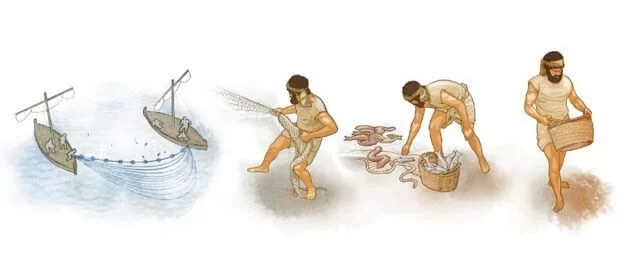
Jesus used the expression weeping and gnashing of teeth in yet one other illustration. In the context of the parable of the wheat and the weeds in the 13th chapter of Matthew, Jesus related a similar illustration, likening the Kingdom of the heavens to a fisherman’s dragnet, saying: “Again the Kingdom of the heavens is like a dragnet let down into the sea and gathering fish of every kind. When it was full, they hauled it up onto the beach, and sitting down, they collected the fine ones into containers, but the unsuitable they threw away. That is how it will be in the conclusion of the system of things. The angels will go out and separate the wicked from among the righteous and will cast them into the fiery furnace. There is where their weeping and the gnashing of their teeth will be.”
What does the dragnet symbolize? According to the June 15, 1992, Watchtower, the dragnet symbolizes both Christendom and Christ’s true congregation. Hence, we read:
“So the dragnet represents an earthly instrument that professes to be God’s congregation and that gathers in fish. It has included both Christendom and the congregation of anointed Christians, the latter having continued to collect fine fish, under the invisible guidance of the angels…”
However, the December 2014 Watchtower discarded the notion that Christendom was part of the symbolic dragnet. Now, the Watchtower teaches what was put forward in the first edition of this publication—with a twist. Instead of depicting a final separation of the faithful from the unfaithful, the Watchtower callously claims that the angels have been removing unsuitable persons from the organization all along. Even persons who may have merely attended a few meetings are subject to being tossed into the “unsuitable” container, for whatever reason, known only to the angels. Strangely, though, the angels have somehow overlooked removing thousands of child predators who have roamed freely in the organization.
But Jesus’ parable of the dragnet illustrates a decisive, final separation that determines the everlasting destiny of those living at a definite point in time. As with the parable of the wheat and weeds, Jesus specified that the angels do the separating work—and not over a prolonged period of time. Furthermore, if the unsuitable fish have not been cast into the fiery furnace, which they obviously have not, then neither have the suitable fish been gathered.
Bethel’s teaching and writing staff ought to find an answer to the question: How many decisive separations are there? That is the appropriate question, given that, according to the Watchtower, there are two harvest-like separations. One has supposedly been ongoing since 1919, and another is scheduled for the future. But are the Watchtower’s teachings really that contradictory? Yes, unfortunately, they are.
THE HARVEST OF THE EARTH IS RIPE
To further establish the Bible’s teaching in this regard and to overturn the “strongly entrenched” dogma supporting 1914, Revelation chapter 14 situates the general harvest during the tribulation period.
How so? As discussed further in this publication, the opening of the sixth seal initiates earth-shaking events associated with what Christ called the great tribulation. However, the tribulation does not immediately lead to Armageddon. Instead, the seventh chapter of Revelation indicates that the angels intercede to hold back the four winds of God’s destructive judgment until all of the remaining 144,000 have been sealed. Jesus spoke of this when he said: “For then there will be great tribulation such as has not occurred since the world’s beginning until now, no, nor will occur again. In fact, unless those days were cut short, no flesh would be saved; but on account of the chosen ones those days will be cut short.”
The holding back of the four winds parallels the cutting short of the tribulation on account of the chosen ones of the 144,000. Evidently, the tribulation will be suspended so that the final sealing may be accomplished. That being the case, the 14th chapter of Revelation establishes the ordering of events after that final sealing. That is evident because the vision of 144,000 standing upon Mount Zion can only signify that Christ’s remnant has finally been sealed at that point, so that the Kingdom is at last complete. Their standing upon Mount Zion with the Lamb of God parallels the gathering of the wheat into the heavenly storehouse.
The vision of Revelation reveals that after the last of the 144,000 sons of the Kingdom have been gathered, then the hour of judgment for the sheep and goats arrives. Thus, Revelation 14:6 reads: “And I saw another angel flying in mid-heaven, and he had everlasting good news to declare as glad tidings to those who dwell on the earth, and to every nation and tribe and tongue and people, saying in a loud voice: ‘Fear God and give him glory, because the hour of the judgment by him has arrived, and so worship the One who made the heaven and the earth and sea and fountains of waters.’”
Immediately after the harvest of the “things in the heavens” and the angelic announcement of divine judgment, then the “harvest of the earth” commences: “And another angel emerged from the temple sanctuary, crying with a loud voice to the one seated on the cloud: ‘Put your sickle in and reap, because the hour has come to reap, for the harvest of the earth is thoroughly ripe.’ And the one seated on the cloud thrust in his sickle on the earth, and the earth was reaped.”
The ordering of events in Revelation matches the sequence of developments Christ foretold for the conclusion. The judgment begins first upon the prospective heirs of the Kingdom.
During his discussion of the sign of his presence and the conclusion of the system of things in the 24th and 25th chapters of Matthew, Jesus gave a series of three parables to illustrate that very thing; namely, the illustration of the faithful and unfaithful slave, the parable of the wise and foolish virgins, and the parable of the talents.
After foretelling how the evil and sluggish slaves will be dismissed from God’s household, Christ next gave the illustration of the sheep and the goats, which has to do with the judgment of all the nations. It is reasonable to conclude that the sheep are those who render good to Christ’s brothers after they have been sealed.
In reality, the Watchtower makes no distinction between the judgment that begins with the house of God and the period of judgment upon the world’s religions.